The opening of 'Dead Mary' for you to analyse.
Thursday

Research : Codes and Conventions of Existing Teen Horror Film Openings (Wrong Turn)
The opening of 'Wrong Turn' which we have analysed in class.
Research: codes and conventions of existing teen horror film opening (dead wood)
The opening to 'Dead Wood' for you to analyse.
Research: thinking about fear

we were in groups and was asked to write down on some papers of what our worse fears are, along with what the fears are we need to write down the reasons why we are scared of these things. three things were put don't about what scare us and they were chosen because they link to different stuff that scare us even more. we did this because we had to find out what fears other people have and for our main task we will have to create 2 mins opening scene to a horror movie and this can help up give us ideas about what actually scare people.
Wednesday
The History of Horror Films : A Journey Through Time
(pre 1930s horror movies)
 Nosferatu
Nosferatu is the very first vampire movie, baldly plagiarising the Dracula story to present Count Orlok, the grotesquely made-up 'Max Schreck', curling his long fingernails round the limbs of a series of hapless victims. Described as the vampire movie that actually believes in vampires, Nosferatu gives us a far more frightening bloodsucker than any of its successors; Shreck is simply inhuman. Murnau demonstrated an early mastery over light and shadow which was to distinguish his subsequent work in Hollywood, such as Sunrise (1927), as well as sheer inventiveness with the photographic image, in the microscope sequences and the stop motion special effects. He also clashed with Bram Stoker's widow over the rights to the Dracula story, which had proved very popular as a stageplay. He changed the names of the central characters, but did not alter the story, and the subsequent legal wrangling meant that prints of the movie were destroyed, Murnau lost control of the film, and it is only relatively recently that a version approximating to the original has become available to the viewing public.The film, shot in 1921 and released in 1922, was an unauthorized adaptation of Bram Stoker's Dracula, with names and other details changed because the studio could not obtain the rights to the novel
 The Golem (1915/1920)
There were several versions of this, dubbed 'the first monster movie', based on the Jewish legends about a clay man created by a magically-inclined rabbi. The 1915 version, purportedly about an antiques dealer who discovers a four centuries old golem and uses it as a personal servant, has been lost, but it was so successful that it generated a comedy about an actor in a golem suit and a prequel, made in 1920, which is the only one of the three films to survive. Paul Wegener directed and starred in the origin story of how the golem came into the world. He is brought to life by Rabbi Loew to save the Jews of sixteenth century Prague from persecution. However, this noble intent is defiled by the Rabbi's assistant, who tries to use the golem for his own nefarious ends, causing chaos in the ghetto.
The Cabinet Of Dr Caligari (1919)
This is largely because the diegetic world is wholly artificial, a complete re-imagining of a Northern German town. The audience views the tale throught the twisted vision of the narrator, where roads, hills, houses and even trees take on a menacing new shape. This is not reality, and the stylised performances reflect that, with the players moving as symbols through the surreal landscape, their stark make up adding to the dreamlike sensation. This contrasted dramatically with the documentary style of film making prevalent in Europe at the time, and proved that film could be a poetic, stylised medium as well as a reflective one. Much has been written on the politics of The Cabinet..., representing as it does puppet humans controlled by a sadistic madman. It certainly struck a chord with German audiences of the time, suffering as they were from the economic consequences of war reparations, helpless in the face of spiralling inflation.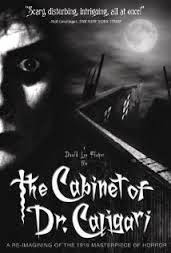 the film used stylized sets, with abstract, jagged buildings painted on canvas backdrops and flats. to add to this strange style, the actors used an unrealistic technique that exhibited "jerky" and dance-like movements. this film is cited as having introduced the twist ending in cinema.
Often cited as the 'granddaddy of all horror films', this is an eerie exploration of the mind of a madman, pitting an evil doctor against a hero falsely incarcerated in a lunatic asylum. Through a clever framing device the audience is never quite clear on who is mad and who is sane, and viewing the film's skewed take on reality is a disturbing experience, heightened by the jagged asymmetry of the mise en scene. Although modern viewers might find the pace slow, with long takes and little cutting between scenes, "The Cabinet..." is stylish, imaginative, and never less than haunting.
preliminary task evaluation
For the preliminary task, we first have to learn what continuity task is referred to. continuity task involving filming and editing a character opening a door, crossing a room and sitting down in a chair opposite another character, with whom she/he then exchanges a couple of lines of dialogue. this task should demonstrate match on action, shot/reverse shot and the 180 degree. corrected for instant clothing, and the location must not change throughout the scene to therefore create an effective continuous scene. match on action: angle but cut during an action to another camera is when showing the action from the same point in time that you left it previous shot. This is important to continue the flow of the scene. Shot/reverse shot • Shot reverse shot is as a film technique where one character is shown looking at another character and then the other character is shown looking back at the first character. Since the characters are shown facing in opposite direction, the viewer assumes that they are looking at each. The 180 degree rule is a very important concept in video and film production. • It refers to an imaginary line which cuts through the middle of the scene, from side to side with respect to the camera. • Crossing the line changes the viewer's perspective in such a way that it may cause disorientation and confusion. For this reason, crossing the line is usually something to be avoided.
 mid shot
 close up shot
 two shot
 extreme close up
 establishing shot
Then we write a plan of what we are going to do for the task and a brief note of what type of show the filming needs: (The location of the setting for each shot is exterior (outside of the school) types of shots that are going to be used are the two shot, tracking shot, shot reverse shot, point of view, close up shot, establishing shot long shot, mid shot, match of action etc.
theres camera movement in tracking shot because there going to be following the character towards the door. it starts with an establishing shot which is going to have the panning camera angle of the school and the whole thing might be 1-2 minutes long with different camera shots and camera movement happening and at the end will have two shot, etc and were going to have the knock knock joke with over the shoulder shots.

storyboard
we made a story board what shows what we are going to do for our filming as in where the location is, what shots and who is going to be the character for the film and then we made example of how its going to be like in given paper and we use that to help us notify what we need for each shots and what it have to look like when we will be filming e.g.


production
we started the film by following our storyboard steps on the location that the filming is going to take place which make the work easier to carry out and through out the filming we had to film two or three time on the scenes to pick the best clips out of all of it and we had some difficulty finding the perfect location like the room that will be used for the knock, knock joke. but luckily we ended up with a suitable place for filming the scene needed. but with the storyboard we had very good ideas and how opinion but the thing that made it a littler difficult is the lack of right equipment and it became more difficult while we were filming, it was extremely winding which therefore the wind sound is affecting the filming but the other filming were successful. also during the filming we ended up doing different shot over again to give us the ability to pick the best one.
post-production
 when the editing was about to be done, i choose the best clips to go with the editing to get the best out of what we have been filming and i imported the to imovie which allows me to cut bits of the clips and joint it together to make a film,
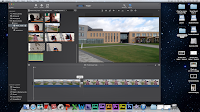
after the import i then cut out bit that aren't wanted and i also removed the background sound that aren't needed for example, the sound of the wind that was not a good impact in the film
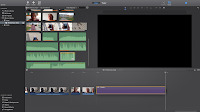
after the removal of the background sound, i then used a site tat allows your to get different sounds that i then used and had to my editing to make it more interesting.
evaluation
overall i think our final piece went well simply because we had no major difficult doing the short film, and it turned out to be straight forward, and we pulled it off by working together to make it the filming work.
i look at the final piece and find out that there is a lot of improvement that could have been done like the angles that the film as been recorded could have been better and there are some angles that made my shadow appear which then had the shadow of the iPad that i was filming with.
pre-production
before we started filming we looked at look at different clips of the oct videos which gives us explanation of guide to 180 degree rule, guide to basic camera rule, guide to basic camera movement, and guides to basic camera shots and one of the videos looked like this:
Then we researched and find camera angle and camera shot for our selves to show that we understand what the rule of film ins are and i showed example of that when i posted images for different shots to proof as my
 mid shotclose up shot
Then we write a plan of what we are going to do for the task and a brief note of what type of show the filming needs: (The location of the setting for each shot is exterior (outside of the school) types of shots that are going to be used are the two shot, tracking shot, shot reverse shot, point of view, close up shot, establishing shot long shot, mid shot, match of action etc.
theres camera movement in tracking shot because there going to be following the character towards the door. it starts with an establishing shot which is going to have the panning camera angle of the school and the whole thing might be 1-2 minutes long with different camera shots and camera movement happening and at the end will have two shot, etc and were going to have the knock knock joke with over the shoulder shots.
storyboard
we made a story board what shows what we are going to do for our filming as in where the location is, what shots and who is going to be the character for the film and then we made example of how its going to be like in given paper and we use that to help us notify what we need for each shots and what it have to look like when we will be filming e.g.
production
we started the film by following our storyboard steps on the location that the filming is going to take place which make the work easier to carry out and through out the filming we had to film two or three time on the scenes to pick the best clips out of all of it and we had some difficulty finding the perfect location like the room that will be used for the knock, knock joke. but luckily we ended up with a suitable place for filming the scene needed. but with the storyboard we had very good ideas and how opinion but the thing that made it a littler difficult is the lack of right equipment and it became more difficult while we were filming, it was extremely winding which therefore the wind sound is affecting the filming but the other filming were successful. also during the filming we ended up doing different shot over again to give us the ability to pick the best one.
post-production


after the import i then cut out bit that aren't wanted and i also removed the background sound that aren't needed for example, the sound of the wind that was not a good impact in the film

after the removal of the background sound, i then used a site tat allows your to get different sounds that i then used and had to my editing to make it more interesting.
evaluation
i look at the final piece and find out that there is a lot of improvement that could have been done like the angles that the film as been recorded could have been better and there are some angles that made my shadow appear which then had the shadow of the iPad that i was filming with.
Thursday
Main Task Set Brief
The titles and opening of a new teen horror film, to last a maximum of two minutes.
All video and audio material must be original, produced by the candidate(s), with the exception of music or audio effects from a copyright-free source.
Subscribe to:
Posts (Atom)